Jerusalem Is Older than Its Famous Walls: How to Understand the City’s Overlapping Histories
By The Israel Desk NewsroomPublished:
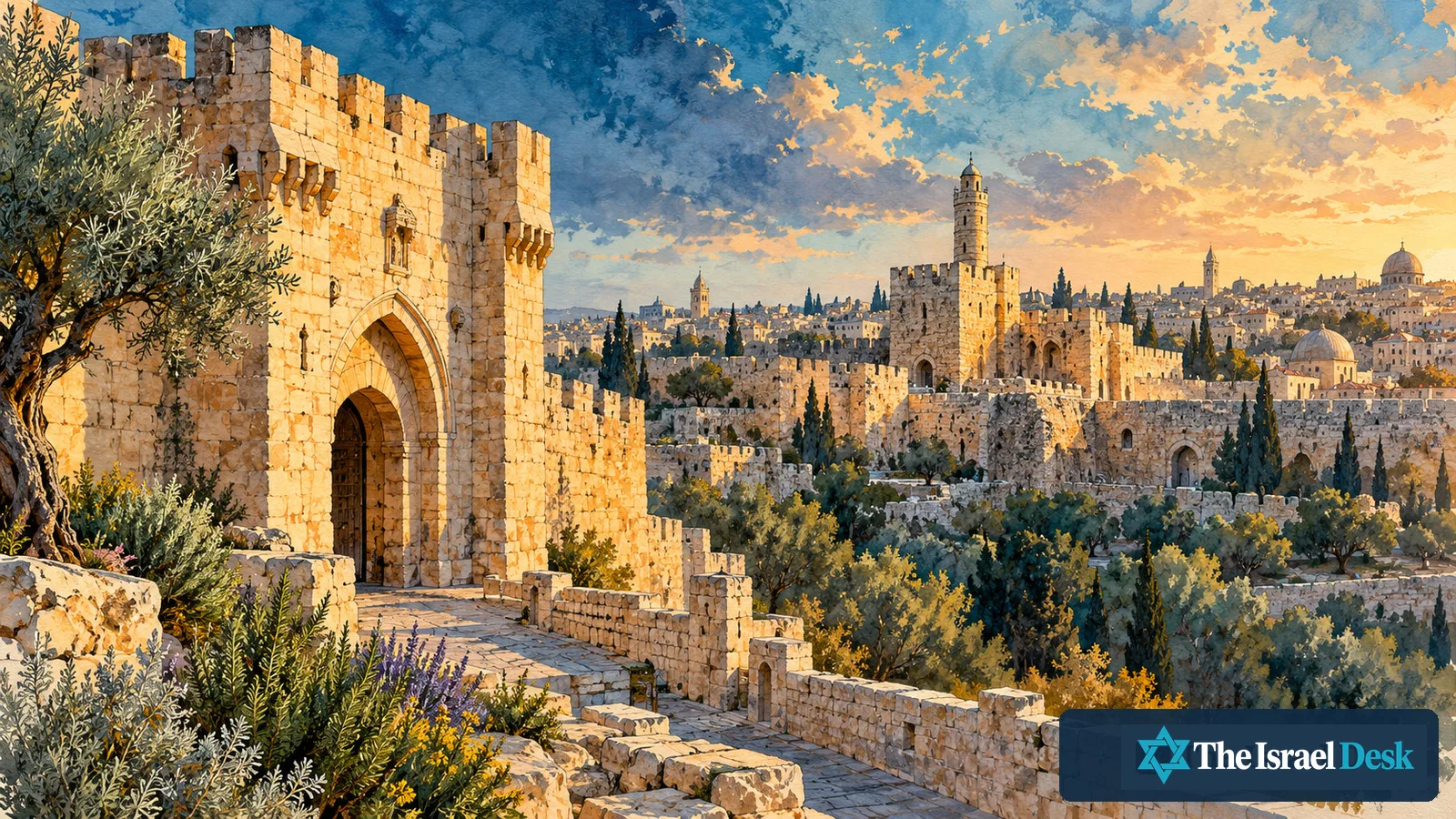
Jerusalem’s familiar Old City walls are largely an Ottoman creation from the sixteenth century. The city’s Jewish history, the Temple periods and many of the traditions attached to its sacred places are much older. A first look can compress these centuries into one ancient skyline; a closer look separates structures, memories and the communities still using them.
The Western Wall belongs to a larger ancient platform
The Western Wall Heritage Foundation explains that the Western Wall is a retaining wall of the Temple Mount compound. It supported the expanded platform associated with the Second Temple, rather than forming the wall of the Temple sanctuary itself. Understanding that engineering function helps make sense of the immense stones and the scale of the surrounding site.
The Romans destroyed the Second Temple in 70 CE. The surviving retaining structures became enduring points of Jewish memory and prayer. For visitors, the important connection is between the physical remnant and the much larger sacred complex that once stood above it. A surviving wall tells only part of a vanished building’s story.
Religious landmarks preserve different historical layers
Christian Jerusalem developed around places connected in Christian tradition with Jesus’s life, crucifixion and resurrection. The Church of the Holy Sepulchre originated in the fourth century, but later destruction, rebuilding and additions shaped the building seen today. Its age cannot be reduced to the date of a single surviving doorway or chapel.
Islamic Jerusalem added another major architectural layer, including the Dome of the Rock in the late seventh century. The Temple Mount, also known to Muslims as Haram al-Sharif, is central to Jewish history and Muslim religious life. These overlapping attachments help explain why the same small area carries meanings that cannot be understood from an architectural photograph alone.
The citadel shows how a city reuses its past
Beside Jaffa Gate, the Tower of David Museum presents the citadel as a site shaped by successive periods. Its account identifies remains and alterations associated with ancient Jerusalem, Roman and Byzantine times, and later Muslim, Crusader, Mamluk and Ottoman rulers.
The museum also explains that the familiar name does not mean the surviving tower was built by King David. Later traditions attached his name to the site. The citadel is especially useful for understanding reuse: rulers repaired, expanded and repurposed existing structures, leaving a building whose visible form belongs to more than one century.
Modern Jerusalem grew beyond the gates
The Old City is not the whole historical city. Jerusalem Municipality dates the establishment of Mishkenot Sha’ananim outside the walls to 1860 and connects the neighborhood with Moses Montefiore. Development beyond the gates changed where people lived and how the city expanded.
That expansion continued into the streets, institutions and neighborhoods of modern Jerusalem. A meaningful visit can therefore pair an ancient site with a district outside the walls, rather than treating everything beyond the gates as background. Read each place through three questions: when was the structure built, which later generations changed it, and what does it mean to the people using it now? The answers turn a collection of landmarks into a city with a continuing history.